Tuesday, November 12, 2013
Letter Against the Firmament (one)
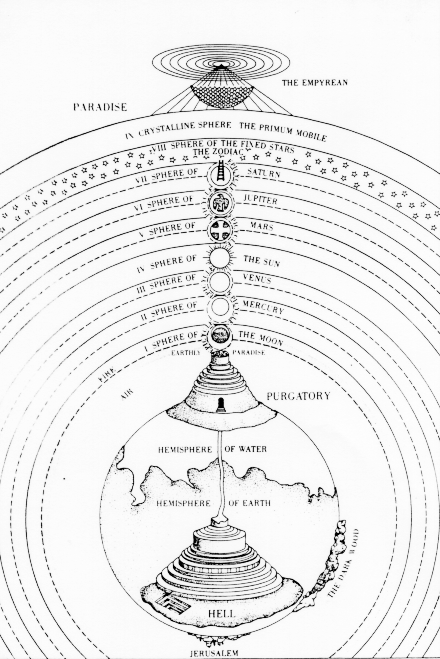
I think I’m becoming slightly unwell. I’ve developed a real fear of the upstairs neighbours. Every morning they emit a foul stench of bitumen and bitter, moral superiority as they stomp through the corridor on their way to work. A while ago I told you I rarely leave the house, now I can’t, they’ve spun a web of 9 to 5 self-worth across the door, a claim on the law, moebus claws. I’m trapped. I keep the curtains closed. Don’t answer the phone. Panic when the mail’s delivered. I don’t know if this is normal behaviour, if anyone else feels the city as a network of claws and teeth, an idiot’s hospital, a system of closed cameras and traffic. I’m probably beginning to smell. In fact I know I am: a thick cloud of inaudible noises from upstairs, dank growlings from somewhere outside the ring of the city. I feel I’m being menaced by judges. Who the hell are they. What are they doing inside me. I can’t hear their voices, but each chain of wordforms solidifies inside my throat, inside my mouth, inside my own voice. It is no articulate sound. It is as if every verb had coagulated into a noun, and the nouns themselves transformed into something subterranean, blind and telescopic. I don’t know if I can even see. I think I injected my eyes with gold one night, or at least the idea of gold, some kind of abstraction, and ever since then I’ve only sensed the city, as a wave of obsolete vibrations and omens. The gold itself some kind of anachronism, a dull rock rolling backwards into whatever remains of historic time. Each time-unit manufactured by a sweatshop suicide somewhere on the other side of the planet. The entire history of London, from its origins as an occultist trading post right up to some point in the not so distant future when it will be inevitably sucked into the spinning guts of Kronos and, well. All of that manufactured by sweatshop suicides, the kind of people my upstairs neighbours will insist over and again simply do not exist. But what do they know? Each evening I hear them, walking around, stomp-stomp-stomping, tap-tap-tapping out their version of social reality on their floor, on my ceiling. It’s terrible. And since I can’t even leave the flat anymore, the ceiling might as well be the whole of the sky, and they’re tapping out new and brutal constellations. Here’s the sign of the surveillance camera. Here’s the medusa. Here’s the spear of Hades. Here’s the austerity smirk. Here’s the budget. A whole new set of stars. Astrology completely rewritten. Its like they’re the sun and the moon, or the entire firmament, a whole set of modernized, streamlined firmaments. What fucking asswipes.
Tuesday, November 05, 2013
Friday, September 27, 2013
Further Notes on Militant Poetics
1. One of the many keys to the meaning of Rimbaud’s “logical derangement of all the senses” is to be found in the title to Joseph Jarman’s 1966 poem “Non-Cognitive Aspects of the City”, aspects further indicated in an early poem of Amiri Baraka’s: “in back of the / terminal / where the circus will not go. At the back of the crowds, stooped and vulgar / breathing hate syllables”. This is a city lacking memory, understanding, visibility, history, money or art. “Aspects” of the city, not areas, meaning that these are not only geographical but psychological zones, zones defined by finance and debt, zones that extend backwards and forwards into history, zones that hang together to create a new / inverted city superimposed onto the one that tourists, bankers and psychogeographers experience: as Frantz Fanon put it, “a zone of non-being, an extraordinarily sterile and arid region, an utterly naked declivity where an authentic upheaval can be born.” Or as an early fiction by Amiri Baraka has it: “the place music goes when we don’t hear it no more . . . the silence at the top of our screams.” The secret of that silence is the secret mutterings of the commodity fetish in its human form, the “screaming commodity” of slavery. Fanon, again: “my long anetennae pick up the catch-phrases strewn over the surface of things”. The strewn catch-phrases are the wreckage of past and future upheavals and oppressions held together in a violent dialectic which, if you know how to hear, are covering the smooth surfaces of the capitalist tradition with the hollering of dead generations.
2. That the “tradition of dead generations weighs like a nightmare on the brain of the living” cuts both ways. There is class struggle among the dead as well. It is not merely that capital is dead labour, but that the networks of monuments that define and lock the official city – its cognitive aspects – are systems and accumulations of dead exploitation. Those monuments have their secrets: Cedric Robinson talks about just one of the many networks of ghosts they were built from: “the [slave-ships] also contained African cultures, critical mixes and admixtures of language and thought, of cosmology and metaphysics, of habits, beliefs and morality. These were the actual terms of their humanity . . . this was the embryo of the demon”. The demon reanimates the subjugated dead, makes them speak. Baraka’s “Leadbelly Gives an Autograph” rescues this dead speech from gothic metaphor: “The possibilities of statement. I am saying, now / what my father could not remember / to say. What my grandfather / was killed / for believing”. Speech as descent into unofficial history and non-cognitive cosmology. A statement that at one point would have been punishable by death is now the only thing worth saying. The tradition it speaks is one of brutality and murder, history a cocophony of wood and rope. The official world puts a ban on apocalypse – Baraka’s poem insists on it.
3. “The forming of the five senses is a labour of the entire history of the world down to the present”. Marx describes the smooth transmutation of human love into stone, metal, money, information and power (the five senses of capital). The possibilities of statement that Baraka would seek to embody in his poem attempt a block on that trajectory, seeking to show that those senses were built from stolen materials, and that they have in any case been violently limited by the forces of capitalist need. In a recent essay Baraka has suggested that the limitation to five senses was produced by capitalist alienation, and that there may be infinite senses, reaching backward and forward into time “in modes, forms and directions that we do not even know exist”. It is at this point that Marx and Rimbaud can be read together: the derangement of the senses, the derangement of “all” the senses, is the derangement of the “labour of the entire history of the world down to the present”. Far from a merely poetic militancy, this is a negation of poetics forcing an active cognition, where Jarman’s non-cognitive aspects of the city come to determine the content and form of what can be known historically, culturally, politically and poetically. In the preface to The Black Jacobins, C.L.R. James said that “the violent conflicts of our age enable our practiced vision to see into the very bones of previous revolutions more easily than heretofore.” The bones of those revolutions can also be dug up to cast new light on our own conflicts. James goes on: “yet for that very reason it is impossible to recollect historical emotions in that tranquility which a great English writer, too narrowly, associated with poetry alone.” James recruits poetry for the revolutionary struggle. It forms a collective with other disciplines. The revolution doesn’t become poetic, poetry becomes revolutionary.
4. The basic truth of Aimé Césaire’s famous proposition – “poetic knowledge is born in the great silence of scientific knowledge” – has changed a little since the early 1940s. Scientific and poetic knowledge are no longer dialectically opposed, both have been sucked into the non-cognitive counter-vortex of corporate knowledge, in which there are no senses to derange, in which all is, as Marx put it, “devoid of eyes, of teeth, of ears, of everything”. This is not to imply that poetic knowledge, thought or writing has a special value due to its absolute irrelevance to corporate nihilism. It is not “the opposite of money”. And it is certainly not, as the fatuous Franco Beradi would claim, revolutionary on account of being a somehow authentic, unmediated communication, as if anything could be. There is, in any case, no more “authentic” communication than the corporate state’s power to refuse you food, shelter and life. Workfare and zero-hours contracts are the poetics of capital. Poetic knowledge, alongside scientific, philosophical, historic, political, militant knowledge are collectively the great silence, the great defect and instability at the centre of corporate knowledge. By virtue of that collectivity, and only though it, they still have their chance.
5. Walter Benjamin, at the beginning of the crisis of the 1930s, wrote of the need for a study of “esoteric poetry”, and of its “secret cargo”. His wager was that the forces of the crisis would enable such a study to reveal the rational kernal of poetic mysticism. “We penetrate the mystery only to the degree we recognize it in the everyday world”, he claimed, “and perceive the everyday as impenetrable, the impenetrable as everyday”. The “impenetrable” exists in two aspects: the invisible lives of migrant workers, benefit claimants etc, and the invisible workings of capital itself, only partially expressed in the lives of the very rich. Part of the intellectual struggle is to grasp these two “mysteries” in the mind at the same time, and to force into view their destructive unity, opening out into infernal history, into hidden constellations, Robinson’s demon. Poetry cannot do this alone, but it has its own way of contributing to the task. René Ménil, publishing alongside Aimé Césaire in Tropiques – an anti-fascist journal disguised as a magazine of poetry and Martinique folklore – wrote that “at every moment the poet is unknowingly playing with the solution to all human problems. It is no longer appropriate for poets to play childishly with their magical wealth; instead, they should criticize the poetic material with the aim of extracting the pure formulas for action”. To extract the magical wealth means that poetry’s intensities can come to match, and occupy the intensity of money. Wealth as Hades, as the accumulated dead labour and sensory reality of history, as the law that fixes reality as conflict, as the “silence at the top of our screams” that becomes audible with the rational clarity of what Hölderlin called “the eccentric orbit of the dead”: an alignment of the planets, the negation of the irrational din of capital itself. The task, as Bertolt Brecht outlined it in the 1930s, is hideous, massive and brutally simple: “we must neglect nothing in our struggle against that lot. What they are planning is nothing small, make no mistake about it. They’re planning for thirty thousand years ahead. Colossal things, colossal crimes. They stop at nothing. They’re out to destroy everything. Every living cell shrinks under their blows. That is why we too must think of everything”.
2. That the “tradition of dead generations weighs like a nightmare on the brain of the living” cuts both ways. There is class struggle among the dead as well. It is not merely that capital is dead labour, but that the networks of monuments that define and lock the official city – its cognitive aspects – are systems and accumulations of dead exploitation. Those monuments have their secrets: Cedric Robinson talks about just one of the many networks of ghosts they were built from: “the [slave-ships] also contained African cultures, critical mixes and admixtures of language and thought, of cosmology and metaphysics, of habits, beliefs and morality. These were the actual terms of their humanity . . . this was the embryo of the demon”. The demon reanimates the subjugated dead, makes them speak. Baraka’s “Leadbelly Gives an Autograph” rescues this dead speech from gothic metaphor: “The possibilities of statement. I am saying, now / what my father could not remember / to say. What my grandfather / was killed / for believing”. Speech as descent into unofficial history and non-cognitive cosmology. A statement that at one point would have been punishable by death is now the only thing worth saying. The tradition it speaks is one of brutality and murder, history a cocophony of wood and rope. The official world puts a ban on apocalypse – Baraka’s poem insists on it.
3. “The forming of the five senses is a labour of the entire history of the world down to the present”. Marx describes the smooth transmutation of human love into stone, metal, money, information and power (the five senses of capital). The possibilities of statement that Baraka would seek to embody in his poem attempt a block on that trajectory, seeking to show that those senses were built from stolen materials, and that they have in any case been violently limited by the forces of capitalist need. In a recent essay Baraka has suggested that the limitation to five senses was produced by capitalist alienation, and that there may be infinite senses, reaching backward and forward into time “in modes, forms and directions that we do not even know exist”. It is at this point that Marx and Rimbaud can be read together: the derangement of the senses, the derangement of “all” the senses, is the derangement of the “labour of the entire history of the world down to the present”. Far from a merely poetic militancy, this is a negation of poetics forcing an active cognition, where Jarman’s non-cognitive aspects of the city come to determine the content and form of what can be known historically, culturally, politically and poetically. In the preface to The Black Jacobins, C.L.R. James said that “the violent conflicts of our age enable our practiced vision to see into the very bones of previous revolutions more easily than heretofore.” The bones of those revolutions can also be dug up to cast new light on our own conflicts. James goes on: “yet for that very reason it is impossible to recollect historical emotions in that tranquility which a great English writer, too narrowly, associated with poetry alone.” James recruits poetry for the revolutionary struggle. It forms a collective with other disciplines. The revolution doesn’t become poetic, poetry becomes revolutionary.
4. The basic truth of Aimé Césaire’s famous proposition – “poetic knowledge is born in the great silence of scientific knowledge” – has changed a little since the early 1940s. Scientific and poetic knowledge are no longer dialectically opposed, both have been sucked into the non-cognitive counter-vortex of corporate knowledge, in which there are no senses to derange, in which all is, as Marx put it, “devoid of eyes, of teeth, of ears, of everything”. This is not to imply that poetic knowledge, thought or writing has a special value due to its absolute irrelevance to corporate nihilism. It is not “the opposite of money”. And it is certainly not, as the fatuous Franco Beradi would claim, revolutionary on account of being a somehow authentic, unmediated communication, as if anything could be. There is, in any case, no more “authentic” communication than the corporate state’s power to refuse you food, shelter and life. Workfare and zero-hours contracts are the poetics of capital. Poetic knowledge, alongside scientific, philosophical, historic, political, militant knowledge are collectively the great silence, the great defect and instability at the centre of corporate knowledge. By virtue of that collectivity, and only though it, they still have their chance.
5. Walter Benjamin, at the beginning of the crisis of the 1930s, wrote of the need for a study of “esoteric poetry”, and of its “secret cargo”. His wager was that the forces of the crisis would enable such a study to reveal the rational kernal of poetic mysticism. “We penetrate the mystery only to the degree we recognize it in the everyday world”, he claimed, “and perceive the everyday as impenetrable, the impenetrable as everyday”. The “impenetrable” exists in two aspects: the invisible lives of migrant workers, benefit claimants etc, and the invisible workings of capital itself, only partially expressed in the lives of the very rich. Part of the intellectual struggle is to grasp these two “mysteries” in the mind at the same time, and to force into view their destructive unity, opening out into infernal history, into hidden constellations, Robinson’s demon. Poetry cannot do this alone, but it has its own way of contributing to the task. René Ménil, publishing alongside Aimé Césaire in Tropiques – an anti-fascist journal disguised as a magazine of poetry and Martinique folklore – wrote that “at every moment the poet is unknowingly playing with the solution to all human problems. It is no longer appropriate for poets to play childishly with their magical wealth; instead, they should criticize the poetic material with the aim of extracting the pure formulas for action”. To extract the magical wealth means that poetry’s intensities can come to match, and occupy the intensity of money. Wealth as Hades, as the accumulated dead labour and sensory reality of history, as the law that fixes reality as conflict, as the “silence at the top of our screams” that becomes audible with the rational clarity of what Hölderlin called “the eccentric orbit of the dead”: an alignment of the planets, the negation of the irrational din of capital itself. The task, as Bertolt Brecht outlined it in the 1930s, is hideous, massive and brutally simple: “we must neglect nothing in our struggle against that lot. What they are planning is nothing small, make no mistake about it. They’re planning for thirty thousand years ahead. Colossal things, colossal crimes. They stop at nothing. They’re out to destroy everything. Every living cell shrinks under their blows. That is why we too must think of everything”.
Wednesday, September 18, 2013
Poem (after Sappho)
the wealthier homes
have occupied my voice
can say nothing now, yes
my language has cracked
is a slow, creaking fire
deadens my eyes, in
high, contorted concern
fuses to protein and rent
*
because your mouth is bitter
with executioners salt, perhaps
when you die, perhaps
you will flutter through Hades
invisible, among the scorched dead
may you vanish there, famished
through the known and unknown worlds
Saturday, August 31, 2013
Letter Against Drowning
I haven't written to you for a while, I know. There's not been much to write about, to be honest, apart from the recurrence of a few elementary social equations. Here's just one, to be going on with - (1) the forced removal of the homeless and benefit claimants from commercial zones (2) the subliminal encouragement of suicide for everyone with less than twenty pounds in their pocket (3) random police checks, arbitrary incarceration, racial profiling. If you take any one of those elements, or any one combination of same, and turn it inside out, the results will be all too simple: one royal birth, one state funeral, pageants, olympic panegyrics, etc etc etc, all expressed via the square root of silence, fast acquiescence and bewilderment. I thought, this morning, that I might be able to put all this together for you, as some kind of wondrous mathematics, a monumental calculus, but I can't get it to fit. It keeps coming out more like an oracular scattering of starling bones, of meat and shrieking larks, an extrasolar dog world made up of three parts rat nationalism divided by the given names of every human being who has died in police custody since the riots. Their names, all paid for with the collective revenue the government has collected from the manufacture, sale and distribution of third degree burns, multiple organ failure, and tiny droplets of phosphoric acid. And that's just the piss-stained surface, yeh. Pretty simple. Manage to boil it down into an infinitely dense, attractively coloured pill and you too can imagine that all of this is just a golden swarm of dragonflies and pretty moths, and not merely an injection of rabies into the group mind of every well-meaning liberal in this entire town. And you ask me why I don't write poetry. As if a metaphor could actually be a working hypothesis, and not just a cluster of more-or-less decorative alibis. I can't do it. I haven't slept since Thatcher. Curses on the midnight hag.
Sunday, August 04, 2013
Letter Against Ritual
So I guess by now you'll have recovered from the voodoo routines at St Pauls. Guess its nice that we won't have to pronounce the syllables Margaret Thatcher again. It all seems very distant now, like when you've been up for four nights, finally get some sleep, and then you're sitting there drinking a cup of coffee trying to remember what the hell you've been up to. You still know that feeling? You'd better. Anyway, the thing I remember most clearly is Glenda Jackson's speech in parliament, when all the rest of them were wittering on about Thatcher and God and the entire fucking cosmos and there was Jackson laying out a few home truths. But really, it's a measure of the weirdness of those few days how fearless that speech seemed: and, obviously, a measure of the weirdness that it actually was some kind of act of bravery. Tho the best bit was when the anonymous Tory MP started wailing “I can't stand it” in the middle of it. Like, that's right, motherfucker. Anyway, so I listened to Jackson's speech on Youtube a few times, and then I went and checked her voting record in parliament - bit of a letdown, yeh. Abstained on the workfare vote, yeh. So that's her, she can fuck off. She made a much better speech back in 1966, I think it was, playing Charlotte Corday in the film of Peter Weiss' “Marat-Sade” - I guess you remember it, she's up at the top of a ladder, going off her head, and screaming something along the lines of “what is this city, what is this thing they're dragging through the streets?”. Christ, if she'd done that in parliament, I might have rethought my relationship with electoral politics. Well, maybe not. But seriously, what was that thing they were dragging through the streets on April 17th, or whatever day it was. Through that silenced, terrified city. I thought of Thatcher as some kind of rancid projectile, and they were firing her back into time, and the reverberations from wherever it was she landed, probably some time in around 1946, were clearly a more-or-less successful attempt to erase everything that wasn't in a dull, harmonic agreement with whatever it is those razorhead vampire suckworms in parliament are actually trying to do with us. Firing us into some kind of future constructed on absolute fear. Or that future is a victorious vacuum, a hellish rotating disc of gratuitous blades, and they are speaking to you, those blades, and what they are saying is this: “one day you will be unemployed, one day you will be homeless, one day you will become one of the invisible, and monsters will suck whatever flesh remains on your cancelled bones”. They're not kidding. And the grotesque and craggy rhythms of those monsters are already in our throats, right now. In our throats, our mouths, the cracked centre of our language, fascist syllables, sharp barking. You know I'm not exaggerating. What they're planning is nothing small. We're talking about thousands of years, their claws extending into the past and into the future. A geometrical city of forced dogs, glycerin waves, gelignite. And what a strange, negative expression of the scandalous joy we were all feeling, at the death-parties, pissed out of our heads in Brixton, in Trafalgar Square, all of those site of ancient disturbances suddenly blasted wide apart. A pack of Victorian ghosts. Nights of bleeding and electricity. Boiling gin and police-lines. White phosphorous. Memories. It was like we were a blister on the law. Inmates. Fancy-dress jacobins. Jesters. And yes. Every single one of us was well aware that we hadn't won anything, that her legacy “still lived on”, and whatever other sanctimonious spittle was being coughed up by liberal shitheads in the Guardian and on Facebook. That wasn't the point. It was horrible. Deliberately so. Like the plague-feast in Nosferatu. I loved it. I had two bottles of champagne, a handful of pills and a massive cigar, it was great. I walked home and I wanted to spray-paint “Never Work” on the wall of every Job Centre I passed. That's right, I'm a sentimental motherfucker when I'm out of my head. But no, already that foul, virtuous fear was sinking back into me, taking possession of my every step. I was thinking about Blanqui, right at the end of his life, sitting in his prison cell, knowing full well that what he was writing he was going to be writing for ever, that he would always be wearing the clothes he was wearing, that he would always be sitting there, that his circumstances would never, ever change. How he couldn't tell the difference between his prison cell and the entire cluster of universes. How the stars were nothing but apocalypse routines, the constellations negative barricades. I was thinking about the work-ethic, how it's evoked obsessively, like an enemy ritual, some kind of barbaric, aristocratic superstition. About zero-hours contracts, anti-magnetic nebulae sucking the working day inside out. Negative-hours. Gruel shovelled into all the spinning pits of past and future centuries, spellbound in absolute gravity, an invisibility blocking every pavement I was walking down. I wanted to cry. In fact I think I did. Actually, no. I was laughing my head off. A grotesque, medieval cackle. No despair, just defiance and contempt. Ancient disturbances. Ghost towns and marching bands. Invisible factories. Nostalgia crackling into pain and pure noise. No sleep. No dreams. An endless, undifferentiated regime of ersatz work. All of us boiled down into some stupid, Tory alarm clock. A ringing so loud we can no longer even hear it. But whatever. It seems pretty obvious we should adopt the Thatcher death-day as some kind of workers holiday. Actually, scratch that, lets just celebrate it every day, for ever and ever, like a ring of plague-sores, botulism and roses. A barbaric carnival of rotten gold and infinite vowels. Sorcery. Rabies. You know what I mean? I hope so. Anyway, things have been pretty quiet since then. I've been thinking about paying you a visit. Oh shit.
*
a rewrite of this piece
*
a rewrite of this piece
Monday, July 29, 2013
Letter Against Hunger / A Foodstamp for the Palace
I'm spending most of my time hungry these days. A real hunger; sharp, greedy and endless. Sometimes I have to stay in bed all day because of it, this maddening weakness, hollow nausea. I bet you think I'm exaggerating. So fuck you. OK, I'm sorry, that was a bit rude. I'll try and explain what I mean by “fuck you”. The High Street. Walthamstow, or anywhere else. Everyone gazing at their reflections in all of the empty shop windows, weird technicians digging up the pavements. Don't think this is delirium, or paranoia. Well maybe it is, but maybe that doesn't matter. The perceptual shifts related to hunger as a means of interpretation. Hunger as beginning of thought. So bear with me. All of those empty shops, full zombie, the absolute calendar. Comedy. History. Masks and plague sores. Mass renunciation, reactionary weather systems, everything. As if the world had shuddered and a massive, spiraling Medusa had scampered through some cheap sci-fi wormhole and was biting us to death. Swallowing and biting. The shop windows, the reflections, are the only hiding place, the only escape. And don't think I'm getting all mythological on your ass. Try to understand that Medusa to be simply the accumulated historical pressure of pure bullshit, or molecules and radio gas, all of it forming a mass intracranial solid neoplasm that, if decoded, may at least give us some sense, the beginnings of an actual map, of what we have to do to reach the next stage - the first stage, it feels like - of what some people still rather quaintly refer to as “the struggle”. Yeh, I know, I'm one of those people. Sometimes my vocabulary makes me cringe. But if those shop windows, those reflections operate as some kind of safety valve, then they are also, put simply, the visible points of an inverted world nailed onto this one, violent, unresting, an insect system where each abandoned hour of what was once called “socially necessary labour time” becomes detached, on its own orbit, like some absolute planet, but habitable, the way an abandoned office space or a derelict private home is habitable. It turns the city inside out. We become property, pure and simple, with no disguises. And so we rent ourselves out, we got no choice. We become derelict storefronts, vacant buildings, fire-traps. We rent ourselves out to a pack of corporate tenants, glass sapphires and enemy systems. Starbucks etc. Just to be obvious. Tesco. A ratpack, sitting there, inside us, eating. All the while eating. Ah, maybe its not so bad. Maybe we can use it, this hunger, this coded swarm. To get a sense of what the murderously rotational teeth of a key, for example, actually mean. To understand what eating actually is. To know what biting is, and subsumption. To understand the secret secular fuck-toys of the entire social labyrinth to be a simple sheet of buckling and starving glass. A brick through the window. A message. And all of that is pretty much what I mean when I use the words “fuck you”. But anyway, that's not why I'm writing. Like the ghost I've become, I'm now looking for a job, and I was hoping you'd write me a reference. You'll do it, of course, I know it.
*
For sale. Everything the management dictated. Celestial dirt and the western scale. The victory of the sailors at Kronstadt. The victory of the miners at Orgreave. The odour of sanctity. Fictional factories. Special discounts on bossnappings, modern landlords and the seekers of lice.
For sale. Top people of all descriptions. Chewing lice, sucking lice, bird-lice. The victory of the rioters at Poundland. Ed Miliband fucked by lice. The defect in the law and the dream deferred. Cameron as nightingale. For sale. Wrapped in wire and torched. For sale. The gospel of saving and abstinence. The victory of the Mau Mau at St James' Palace. Infrageography. Microtomes. Tactical spectrums. Sudden harmony and affliction. The corrosive victory of the unemployed. A carbomb for the DWP.
------------------------------
versions of earlier pieces here and here
*
For sale. Everything the management dictated. Celestial dirt and the western scale. The victory of the sailors at Kronstadt. The victory of the miners at Orgreave. The odour of sanctity. Fictional factories. Special discounts on bossnappings, modern landlords and the seekers of lice.
For sale. Top people of all descriptions. Chewing lice, sucking lice, bird-lice. The victory of the rioters at Poundland. Ed Miliband fucked by lice. The defect in the law and the dream deferred. Cameron as nightingale. For sale. Wrapped in wire and torched. For sale. The gospel of saving and abstinence. The victory of the Mau Mau at St James' Palace. Infrageography. Microtomes. Tactical spectrums. Sudden harmony and affliction. The corrosive victory of the unemployed. A carbomb for the DWP.
------------------------------
versions of earlier pieces here and here
Subscribe to:
Posts (Atom)


.jpg)


